

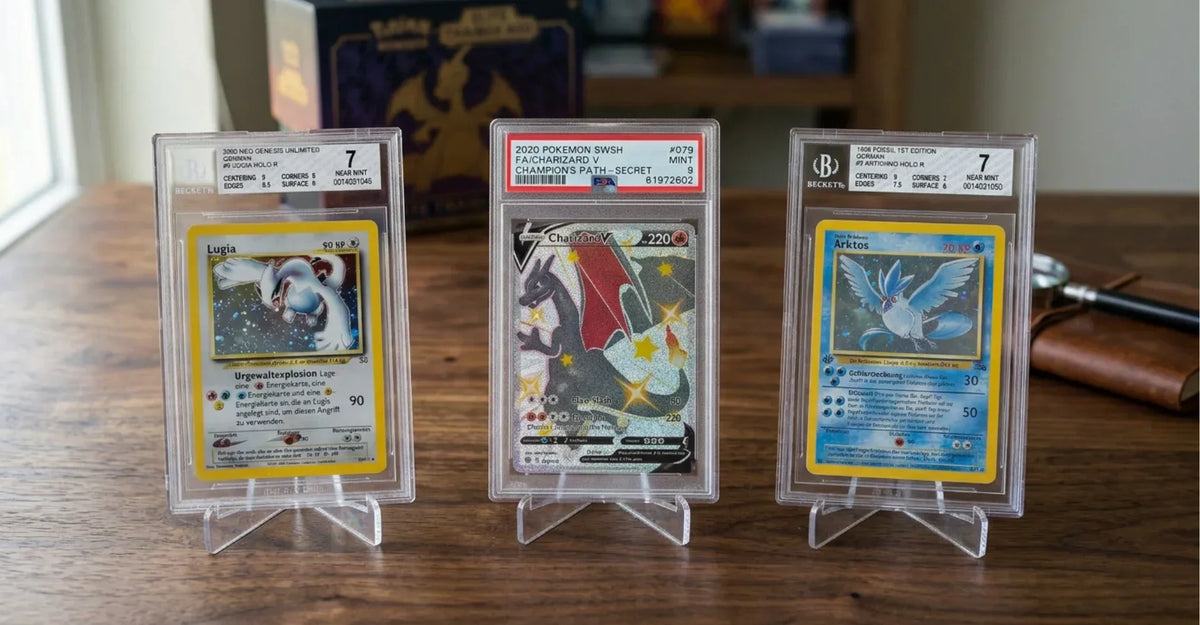
Graded Cards have become an integral part of the Trading Card Game world. Whether Pokémon, Magic: The Gathering, Yu-Gi-Oh!, Disney Lorcana, One Piece, or Star Wars: Unlimited - more and more Collectors want to know exactly what Condition their card is in. Professional Grading makes this visible: the card is examined, evaluated, and then sealed in a protective holder.
In this guide, we explain what makes Graded Cards special, how grading works, which Grading companies are particularly well known, and what you should look out for when you want to buy or sell Graded Cards.
What does “Graded Card” actually mean?
A Graded Card is a trading card that has been examined and evaluated by an independent Grading company. The focus is primarily on two things: the card’s authenticity and its Condition. After the examination, the card receives a grade, usually on a scale from 1 to 10. It is then sealed in a sturdy, tamper-resistant plastic Sealed Case. This Sealed Case is often referred to as a “Slab”.
The Slab’s label usually contains important information such as the card’s name, set, card number, Language or variant, Grading provider, certification number, and, of course, the grade. This turns a loose trading card into a documented collectible with a clearly traceable Condition.
That is precisely what makes Graded Cards so interesting to many Collectors. With an ungraded card, the assessment often depends heavily on the eye of the beholder. What is “near mint” to one person may already look “excellent” to another. A Graded Card makes comparisons easier - especially for rare, expensive, or emotionally important cards.
Why do Collectors have cards graded?
The reasons for Grading vary. Some Collectors want to protect their favorite card for the long term. Others want to assess a card’s value more accurately or sell it more easily later. Still others deliberately build a Collection of PSA 10, BGS 9.5, or CGC 10 cards.
Especially with popular TCGs such as Pokémon, Magic: The Gathering, or Lorcana, a good grade can make all the difference. A rare card in poor Condition is still rare, but is often much less sought after than a very well-preserved example. A high grade shows buyers at a glance: This card has been professionally examined and is in very strong Condition.
It is also important to note that not every card is automatically worth grading. Grading costs money, takes a certain amount of time depending on the provider, and does not increase the value of every card to the same extent. It is often particularly worthwhile for rare cards, popular characters, older sets, limited promos, tournament cards, or modern Chase Cards in near-perfect Condition.
How is a card graded?
Although each provider has its own details and standards, Grading companies usually focus on similar core areas. The key factors are centering, corners, edges, and surface.
Centering
Centering describes how evenly the card artwork is positioned on the card. If the borders on the left and right or at the top and bottom are noticeably different in width, this can lower the grade. Centering plays a major role, especially with very high grades such as 9.5 or 10.
Corners
A card's corners reveal a lot about its Condition. Sharp, clean corners indicate a well-preserved card. Small white spots, pressure marks, or bumped corners, on the other hand, can lead to deductions.
Edges
The edges are also examined closely. White spots or minor damage are particularly noticeable on cards with dark borders. With some modern cards, even minimal production or cutting flaws may be visible.
Surface
The surface is one of the most important and, at the same time, most sensitive areas. Scratches, print lines, dents, stains, fingerprints, or minor production flaws can affect the grade. Holo cards and Full-Art cards in particular often show surface flaws especially clearly.
What do grades such as PSA 10, BGS 9.5, or CGC 10 mean?
Most well-known Grading providers use a scale from 1 to 10. A 10 represents a near-perfect or perfect Condition, while lower grades indicate more pronounced signs of wear, damage, or aging. For Collectors, the upper range is particularly interesting: 8, 9, 9.5, and 10.
However, a 10 does not mean exactly the same thing with every provider. PSA 10, BGS 10, CGC Pristine 10, and TAG 10 each follow their own criteria and market conventions. Therefore, you should not look only at the number, but also at the provider, the card itself, demand, and comparable sale prices.
PSA 10
PSA is one of the best-known names in Trading cards Grading. A PSA 10 is called “Gem Mint” and represents a card in exceptionally strong Condition. PSA is particularly prominent internationally for Pokémon cards. Many collectors specifically look for PSA 10 cards because they are easy to compare and well established on the market.
BGS 9.5 and BGS 10
Beckett Grading Services, or BGS for short, is also very well known. BGS is particularly popular for its Subgrades. Individual areas such as centering, corners, edges, and surface are graded separately. A BGS 9.5 is often perceived as “Gem Mint” and is highly sought after by many collectors. BGS 10 Pristine and the famous Black Label are especially desirable; all Subgrades must be perfect to receive one.
CGC 10
CGC Cards is strongly represented in the TCG sector and also grades cards on a 10-point scale. The distinction between Gem Mint 10 and Pristine 10 is particularly important. A Pristine 10 represents an exceptionally strong example and is given special prominence by CGC.
SGC 10
SGC is particularly well known in the sports card sector, but also plays a role in Trading cards. The slabs are quickly recognizable by their dark, clean design. Here too, a 10 represents a card in very high Condition.
TAG 10
TAG is a modern provider that focuses particularly on technology, transparency, and detailed digital reports. In addition to the classic 1-to-10 rating, TAG uses a more precise score that classifies cards in even finer detail. This may be interesting for collectors who value highly detailed Condition data.
The best-known Grading providers at a glance
There are now many Grading companies. Some are established worldwide, while others are more popular regionally. For market value, not only the grade matters, but also which provider graded the card. The following providers are among the best-known names in the hobby:
PSA – Professional Sports Authenticator
PSA is considered the international standard by many collectors. PSA is particularly strong in Pokémon and sports cards. PSA cards are easy to compare on the market because there are many sales histories and strong demand. Anyone looking to buy or sell graded Pokémon cards will very often come across PSA.
BGS – Beckett Grading Services
BGS is known primarily for its Subgrades. Collectors can see more precisely why a card received its overall grade. This makes Beckett particularly interesting for high-value cards, where minimal differences can have a major impact on the Price.
CGC Cards
CGC is strongly positioned in the field of Trading cards, comics, and collectibles. In TCGs such as Pokémon, Magic, or Yu-Gi-Oh!, CGC has gained significantly more visibility in recent years. The labels are clearly structured, and particularly high grades such as CGC Pristine 10 are sought after by Collectors.
SGC
SGC has a long history in the card market and is especially well known for sports cards. The black slabs have a distinctive look and are appreciated by many Collectors. In the TCG sector, SGC is not always the first choice, but it remains a relevant name.
TAG
TAG focuses heavily on technical evaluation, precise data, and digital transparency. The additional score can help compare two cards with the same grade of 10 more precisely. This is particularly appealing to Collectors who want to see more than just a grade, but also the details behind it.
Other providers
In addition to the major international names, there are also providers such as ACE Grading, AOG, GRAAD, and other regional grading services. Depending on the market, design, Price, and personal preference, these may also be interesting. When reselling, however, you should always check how strong demand for the respective provider is among buyers.
Are Graded Cards automatically valuable?
No. A graded card is not automatically expensive. Its value still depends on several factors: Which card is it? Which set is it from? How rare is it? What Language is it in? How popular is the artwork? How high is the demand? And, of course: What grade did it receive?
A common card with weak demand does not suddenly become a top collectible just because it has been graded. Conversely, a rare card with a high grade can become significantly more attractive because buyers have greater confidence in its Condition and authenticity.
Particularly strong combinations include iconic Pokémon such as Charizard, Pikachu, Mewtwo, or Rayquaza, old WOTC cards, rare promos, Alternate Arts, Trophy Cards, or highly sought-after cards from modern sets. Graded cards from Magic: The Gathering, One Piece, Disney Lorcana, or Star Wars: Unlimited can also be interesting when Rarity, Condition, and demand align.
Buying Graded Cards: What Should You Look Out For?
If you want to buy a Graded Card, you should not just look at the number on the label. Also check whether the card fits your Collection, how liquid it is on the market, and whether the Price is reasonable compared with comparable sales.
Also pay attention to the certificate number. Reputable Grading providers offer an online check that allows you to retrieve details about the card. This makes it easier to assess whether the label, card, and Sealed Case match.
For Beginners, Graded Cards are particularly convenient because the Condition has already been documented. You do not have to assess every small detail yourself and can compare cards more effectively. Nevertheless, it is worth taking a close look: Even cards with the same grade can look different visually.
Sell Graded Cards: Why direct purchase can be worthwhile
Anyone who wants to sell Graded Cards often faces the question: marketplace, auction, or direct purchase? Platforms can bring good prices, but they also involve effort: taking photos, writing a description, answering messages, keeping fees in mind, organizing shipping, and planning for possible complaints.
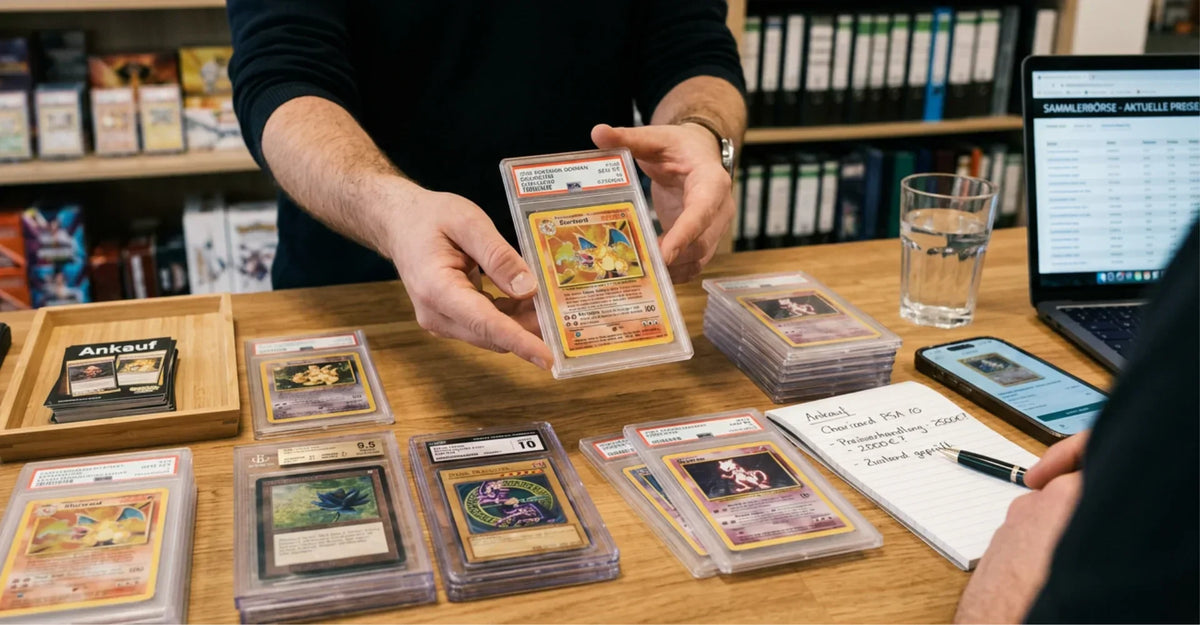
A direct purchase can be much more relaxed. At cardcosmos, you can not only sell individual cards, bulk, and Collections, but also offer Graded Cards. This is especially convenient if you own multiple Graded Cards or want to dissolve a Collection.
We evaluate your cards transparently and in line with the market. It is not just the provider and grade that matter, but also the card, set, Language, demand, and current market conditions. Whether Pokémon, Magic: The Gathering, Yu-Gi-Oh!, One Piece, Disney Lorcana, Star Wars: Unlimited, or other TCGs - we are happy to take a look at high-quality cards and interesting Collections.
Is Grading worthwhile for my own cards?
Whether Grading is worthwhile depends on your card and your goal. If you find a card particularly valuable emotionally and want to protect it long-term, Grading can make sense regardless of its market value. If your main goal is resale, you should calculate realistically beforehand.
Ask yourself: Is the card rare enough? Is it in truly strong condition? Is there demand for this card as a Graded Card? Are comparable sales significantly higher than those of ungraded copies? And is the potential added value worthwhile after deducting the Grading costs?
Especially with modern cards, the difference between a 9 and a 10 is often enormous. A card that looks perfect at first glance may still receive a lower grade due to minor surface flaws, slight off-centering issues, or minimal edge defects. That is why a thorough preliminary inspection is worthwhile.
Graded Cards build trust, protection, and comparability
Graded Cards are more than just Trading cards in plastic. They combine authenticity verification, Condition assessment, and long-term protection in a single Collectible. For buyers, they offer greater security; for sellers, a clearer Price basis; and for Collectors, a great way to preserve special cards permanently.
Whether it's a PSA 10 Charizard, BGS 9.5 Magic card, CGC Pristine 10 Pokémon card, or a modern TAG-graded card: what always matters is the combination of card, Condition, provider, demand, and Price. Understanding these factors makes it much easier to assess graded cards.
If you want to buy graded cards, cardcosmos regularly offers exciting Graded Cards for Collectors and TCG fans. And if you want to sell graded cards, you can easily offer us your cards or Collection. We evaluate them fairly, transparently, and with the current market in mind.
FAQ: Frequently asked questions about graded cards
What is a graded card?
A graded card has been examined and evaluated by an independent grading company and sealed in a protective Slab. The grade indicates the card's Condition.
Which grading providers are particularly well known?
Some of the best-known providers include PSA, Beckett/BGS, CGC, SGC, and TAG. There are also other providers such as ACE Grading, AOG, and GRAAD.
Is PSA 10 better than BGS 9.5?
There is no general answer to this. PSA 10 and BGS 9.5 are both very high grades, but they are perceived differently on the market. The value also depends on the card, demand, Subgrades, and comparable sales.
Can I sell graded cards to cardcosmos?
Yes. cardcosmos also buys graded cards. Particularly interesting are sought-after cards from well-known grading companies, as well as high-quality individual cards and collections from popular TCGs. To sell your cards, it is best to use the purchase form on our website.
Which graded cards are particularly sought after?
Rare Pokémon cards, popular characters, old sets, limited promos, Alternate Arts, Trophy Cards, and cards with very high grades such as PSA 10, BGS 10, or CGC Pristine 10 are often particularly sought after.








Leave a comment
This site is protected by hCaptcha and the hCaptcha Privacy Policy and Terms of Service apply.